
 lab
The weak signal. From an observation to an indicator
A weak signal is early, imprecise information about a possible change. The lab keeps such information in one register for every horizon, and a signal worth watching gets an indicator.

A weak signal is early, imprecise information about a change that may happen. The idea comes from Igor Ansoff's article "Managing Strategic Surprise by Response to Weak Signals" (1975). His point was simple: by the time a change is visible to everyone, little time is left to prepare for it.
One of the lab's tasks is called warning: noticing weak signals before they become an obvious crisis. This post describes how a signal travels from an observation to an assessment.
How a signal differs from news
News reports what has already happened. A signal speaks of what may happen, and on its own it almost never proves anything: a patent application, the first use of a term in a trade publication, a change in the text of a draft regulation, an unusual purchase.
A signal is selected by one question: what changes if it turns out to be the start of a trend. An observation with no answer to that question stays an observation.
One register for every horizon
The lab works on three horizons: near (up to two years), strategic (two to five) and far (five to fifteen). The near horizon belongs to analysis, the other two to advanced research. Signals pass between them through one shared register: a signal noticed on the far horizon may in time land on the near one.
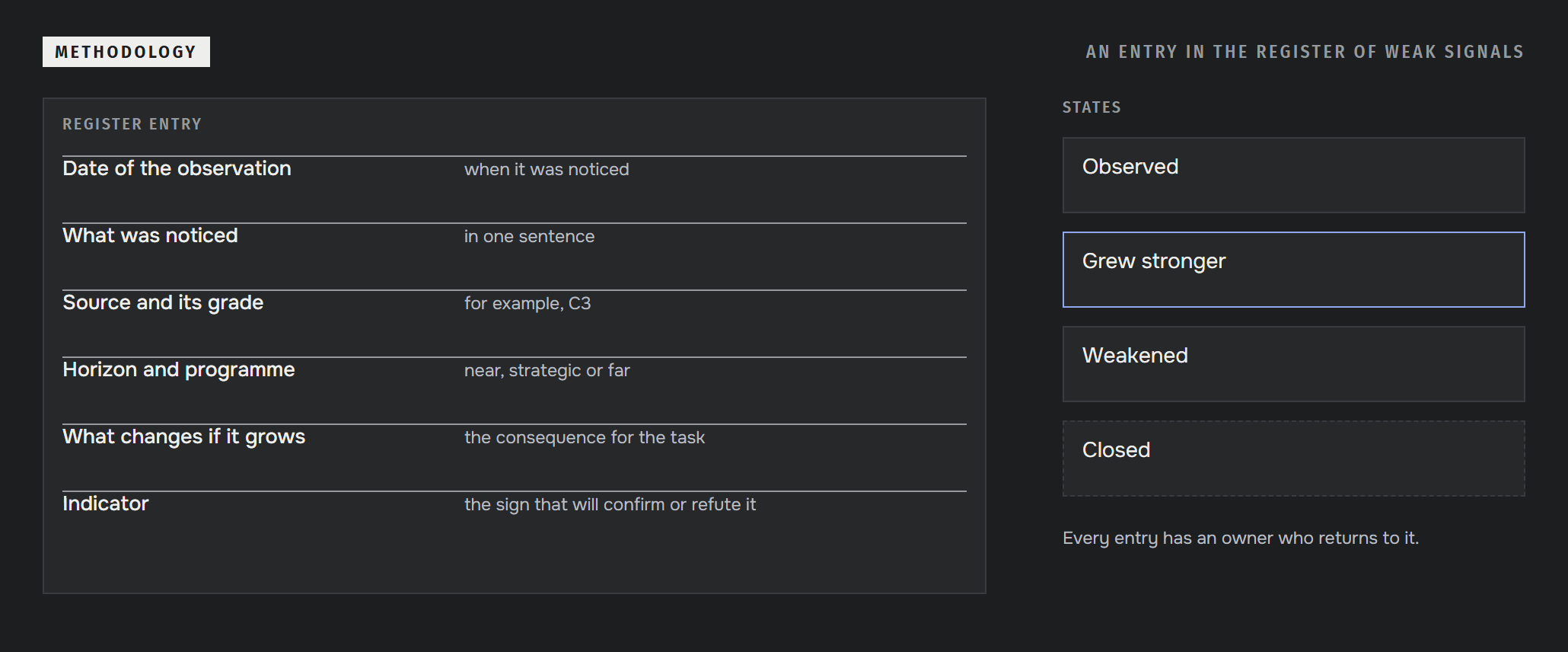
Every entry in the register has the date of the observation, the observation itself in one sentence, the source and its grade, the horizon and the programme, the consequence for the task and an indicator. Each entry has an owner who returns to it and changes its state.
From a signal to an indicator
An indicator is a sign whose appearance will confirm or refute an assumption. Unlike a signal, an indicator is named in advance and checked.
A good indicator has three properties. It is observable: it can be seen in open sources. It is specific: it is clear what counts as its appearance. It has a deadline: it is clear when the absence of the indicator becomes information in itself.
Indicators go into the block of the same name in the analytical note. If an indicator appears, the assessment is revised, and that shows in the forecast register.
Common mistakes
- Noise taken for a signal. Every unusual event goes into the register, and in the register the important can no longer be told from the accidental.
- One source as a trend. Five publications retell one observation, and the signal looks stronger than it is.
- A signal fitted to the desired scenario. What confirms the analyst's expectations gets into the register, and what contradicts them is lost.
- A signal with no owner. The entry is made and forgotten. A year later nobody knows whether the signal grew stronger or weakened.