
 lab
Product
 CATK
A product for running an investigation in which the support for every statement is visible. It works in the browser, by default the data stays on your machine, and the result is exported as a file an outside newsroom can check.

01
Purpose
An investigation is usually kept in a spreadsheet, a folder of documents and a chat. While one person runs it, that person remembers where everything came from. Once there are more people or more time, that knowledge is lost.
- The forgotten origin of a statementWho said it, which document supports it, whether anyone checked — all of that is in someone's head, or nowhere.
- Evidence for the editor and the lawyerIt gets collected again, from memory, right before the piece goes out.
- An unnoticed weak spotA chain of four relations with not one document behind it looks the same on a diagram as a checked one.
CATK is built for that problem: the diagram in it shows what each statement rests on.
02
Capabilities
Unsupported chains
Rules check each record: a relation with no evidence, a disputed relation with no source, two records under one name, a place named but not located. Analysis looks for what only the whole structure shows: two or more unsupported relations in a row, a load-bearing relation with no evidence, two records with shared neighbours and no relation between them.
Every proposal can be shown in the graph, turned into a verification task, or dismissed. A person edits the record — the product only proposes.
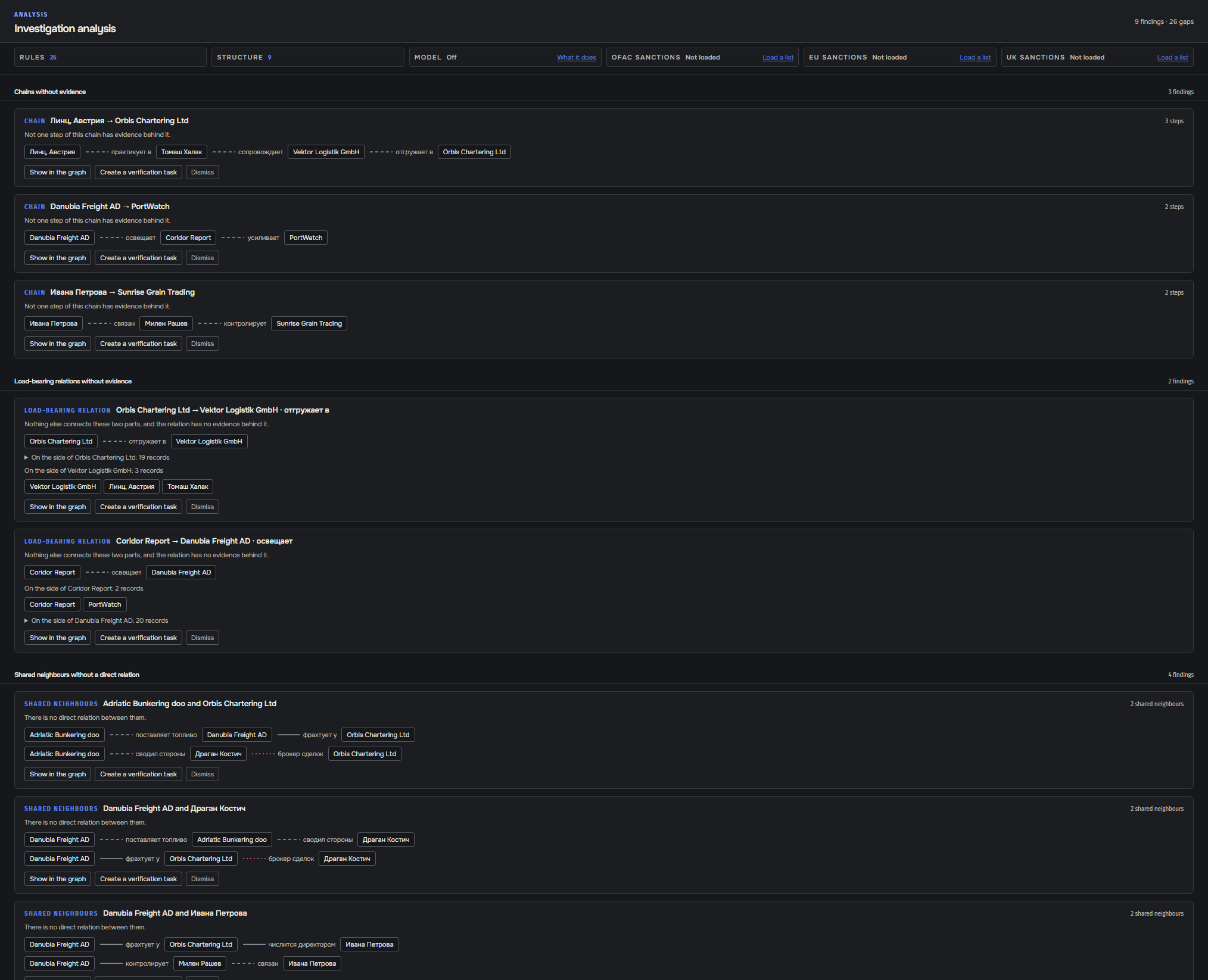
AnalysisAcross the top, the sources of proposals: rules, the shape of the graph, the model and three sanctions lists. The model is off in this workspace and the lists are not loaded. Below them, the findings: chains without evidence, load-bearing relations, shared neighbours without a direct relation. Demonstration set: every person and company in it is invented. The set is written in Russian. Verification marks
Every record carries four marks: the source is named, a document is attached, the verification task is closed, a second person has confirmed. The marks do not add up to a percentage, and each can be checked by looking at the record itself. The number on the right of the card belongs to another field: it is the analyst's estimate, and a person sets it.
The second analyst signs the record with their own key on their own machine and sends the signature as a file. No server is involved.
Verification progress: 1/4
- Source named
- Document attached
- Verification task closed
- Countersigned
RecordA card up close: the number of relations on the left, the analyst's estimate on the right, and the four verification marks along the bottom edge. Demonstration set: every person and company in it is invented. The set is written in Russian. Five views of one set of data
Canvas, chronology, a chart by date, a map and analysis. The same records lie under all of them, and a filter applies everywhere at once.
On the map a record can have an area and a relation a route: they are drawn with clicks on the map or typed in as coordinates.
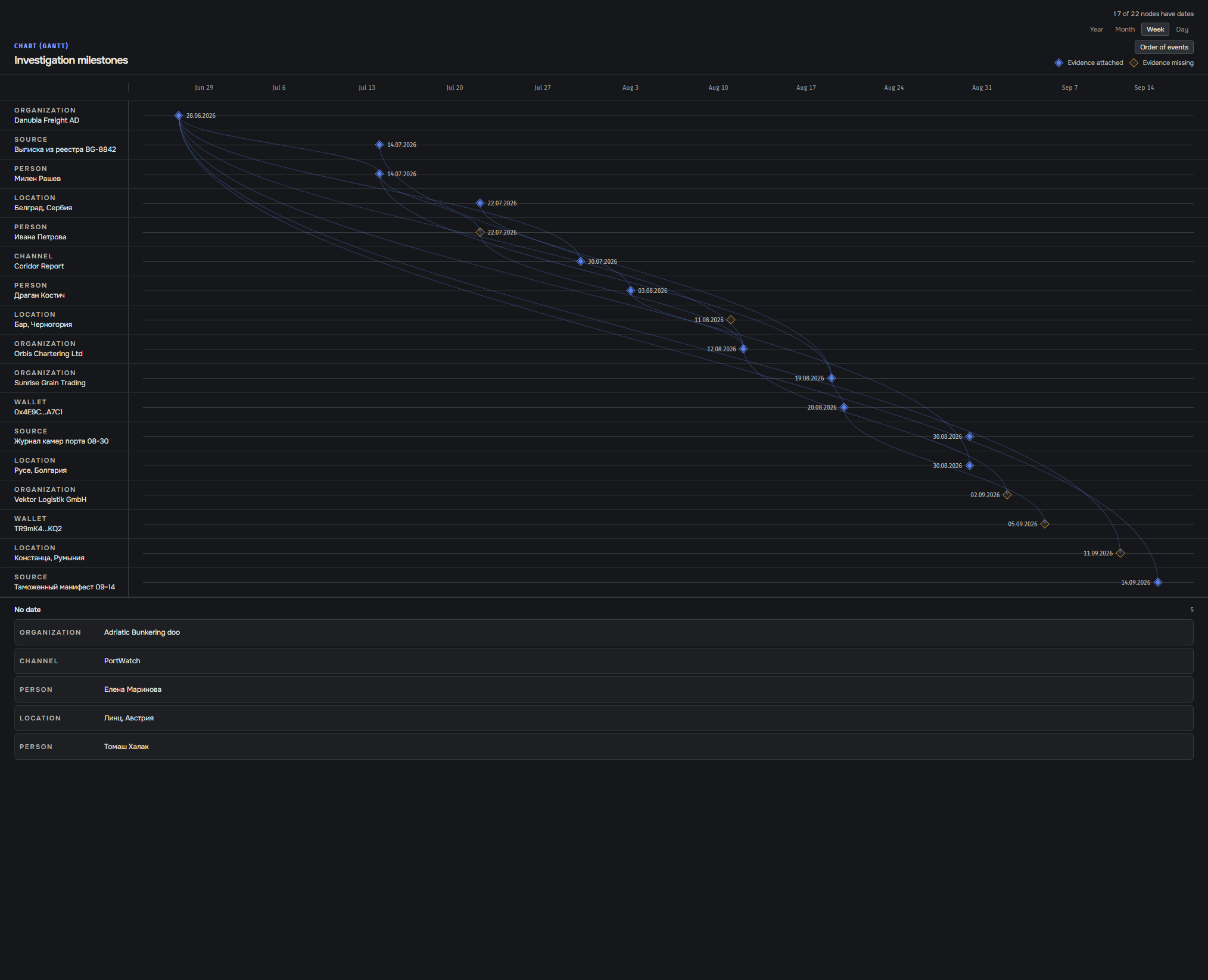
ChartDated records along one scale, the order between them where it was established, and a list of the records that carry no date. Demonstration set: every person and company in it is invented. The set is written in Russian. 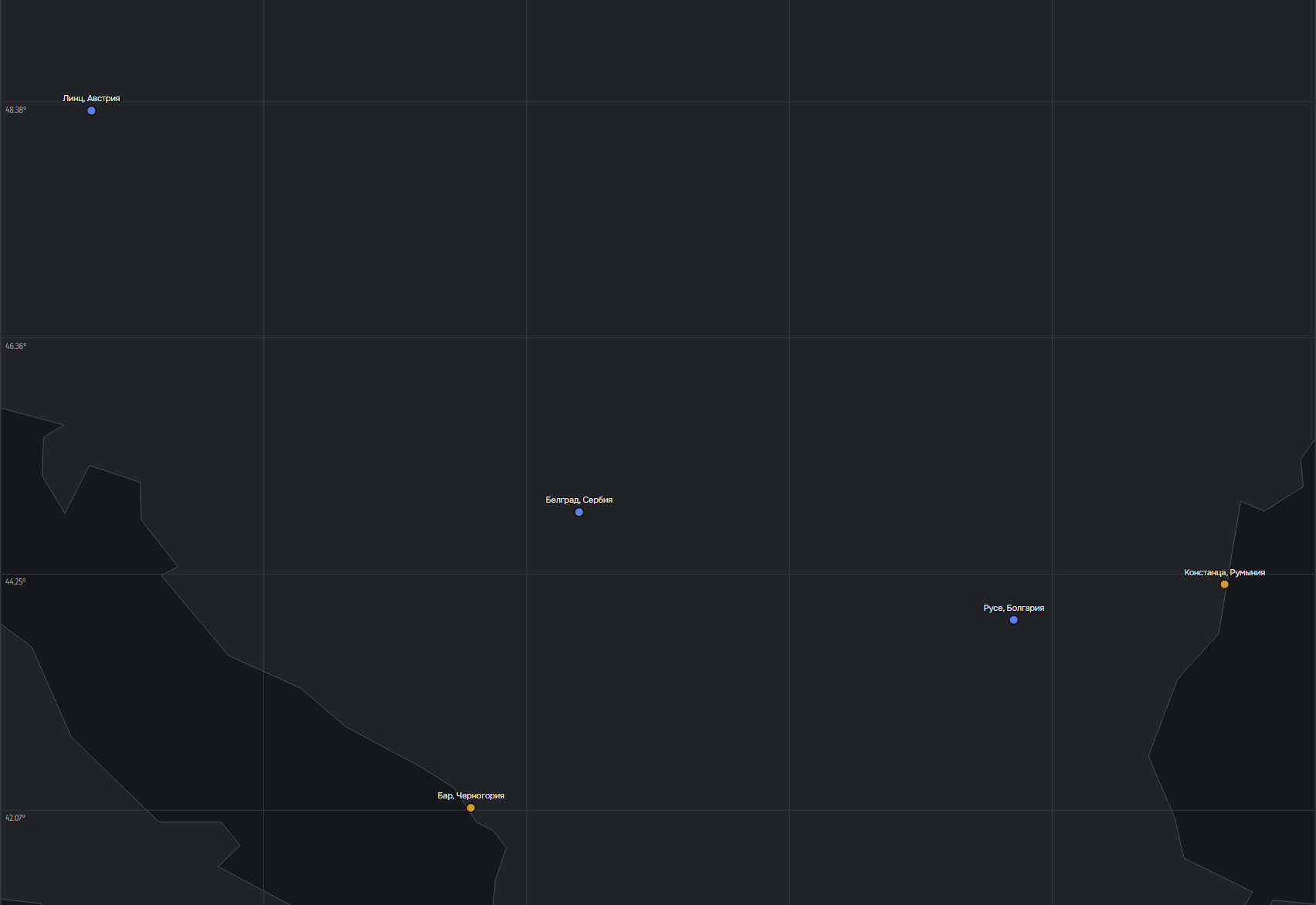
MapA place is a name and a point, and neither is derived from the other. Demonstration set: every person and company in it is invented. The set is written in Russian. Sanctions screening
The OFAC, European Union and United Kingdom lists are loaded from files the analyst downloaded. Records are compared by name, IMO number and wallet address, and every match arrives in Gaps as a proposal that names its list.
A match changes nothing in the record and is not proof: namesakes are told apart by date of birth, citizenship and registration numbers. There is no similarity percentage.
Model proposals
The Anthropic model is asked about one record at a time: the Ask the model button sends the record and its relations. It proposes what a rule cannot see: a person named in the description who is missing from the graph, two fields that disagree about a date, a sharper label for a relation. Every proposal comes with a quotation, and the product keeps it only if each quotation appears word for word in the field it names.
Proposals arrive in Gaps beside the rules and the sanctions lists, and a person still edits the record. The model is off by default and is switched on for each workspace separately, because the request carries the record's text to Anthropic. The key and the bill belong to the analyst: the key stays in their browser and does not go into workspace files.
Open sources about a record
For a person, an organisation or a vessel the product shows a Wikidata dossier: country, owners, managers, dates and registration numbers. A domain snapshot collects the registration data, DNS records, the names in certificates and the web archive's captures. Both answers are saved as a document of the record, with the time of the request and a SHA-256 hash.
A Wikidata statement becomes a relation in the graph only when the analyst asks for it, and it is marked as borrowed and not checked here. Both requests are switched on for each workspace separately, because they tell an outside service who or what is being looked into. The dossier takes nothing about a person's family or home, and the snapshot does not take the owner's name, email address or phone number.
Publishing the material
A piece from the Newsroom is printed or saved as PDF, as DOCX and as a publication file. The publication file carries the piece and the records it stands on: their relations, evidence, document hashes, signatures and closed verification tasks.
The file format is published with a JSON Schema. The verification page reads a file, names what supports each statement and sends the file nowhere. A whole workspace is transferred as one archive with its attached documents, and the file can be locked with a passphrase.
Storage of data
By default there is no server and no account. Synchronisation with the analyst's own server can be switched on for a workspace: the investigation is encrypted on the device before it goes there, and the server cannot read it. The server does see who writes, from where, when and how much.
Outside sources (map tiles, place lookup, Wikidata, the domain snapshot, the exchange with Aleph, the model) are off by default and are switched on one at a time for each workspace. Each one is labelled on screen with what its request gives away.
Working together
Several analysts run one workspace through their own synchronisation server. Edits are distributed automatically, each signed by its author's device, and an entry that fails the check is not applied. Documents are transferred too, each encrypted with its own key.
A member is added by a card with a key fingerprint, and the fingerprint is checked with that person by voice or in person. When two people change the same record, the journal's version stands and the other one waits for the analyst's decision.


03
Templates
Files CATK opens with the Import button: a template for a class of work and the demonstration set.
- A template for your class of workA workspace file with roles to fill in and questions to answer. In the product it opens with Import → Workspace.
The note saying this is a template is written inside each file, because the file stays with the reader after the page changes.
- The demonstration setTwenty-two records, eleven pieces of material and ten tasks, every one of them invented. The same Import button.
04